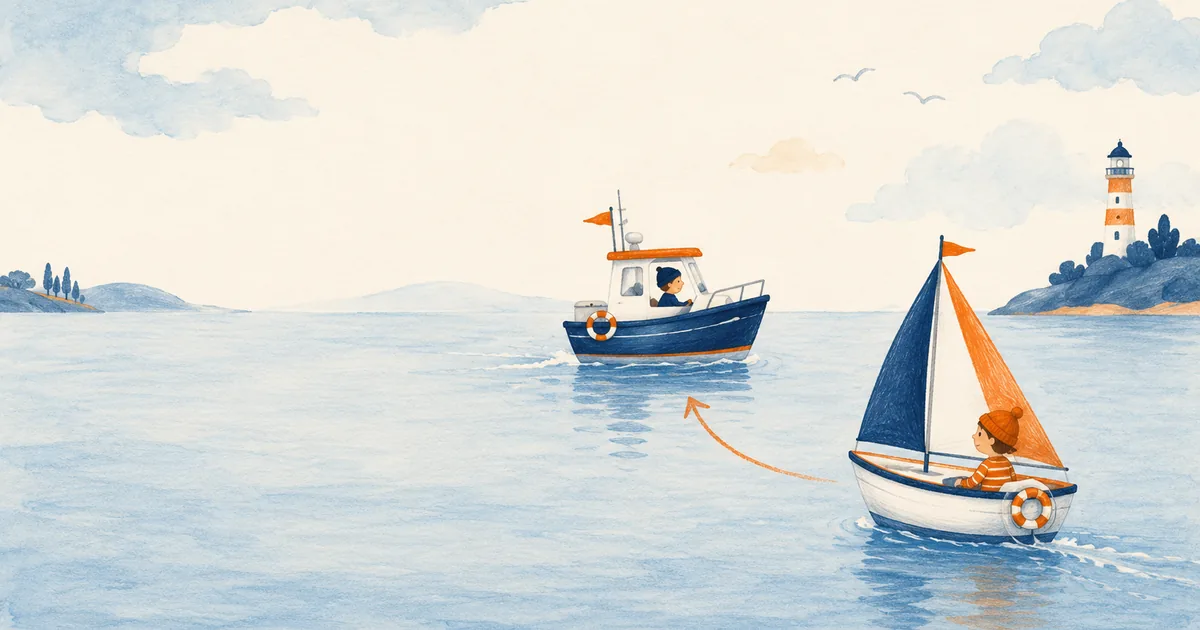
Interactive decision drill
Who gives way? Work through the situation in the right order
Choose the description that best fits the question. The drill keeps “risk first, situation second, action third” visible, so you learn the decision path rather than memorising a picture.
Two power-driven vessels are crossing. The other vessel is on your starboard side; bearing is steady and range is closing.
- Risk? Yes — steady bearing and decreasing range.
- Situation? Crossing under Rule 15.
- Your role? Give-way vessel: take early and substantial action and avoid crossing ahead if circumstances permit.
Quick check: the other vessel is on your port side. Are you free to ignore her?
No. You are normally the stand-on vessel in this crossing situation, so initially keep course and speed — but keep monitoring. If the give-way vessel does not act, Rule 17 allows and, when collision cannot otherwise be avoided, requires you to take action.
Study aid only. Real navigation also depends on visibility, local conditions, narrow channels, traffic-separation schemes and vessel status. Always apply the full COLREGs and good seamanship.
The collision regulations are the part of the pleasure-vessel Grade 2 written exam that most rewards genuine understanding and time spent—because they affect not only your exam score but safety at sea itself. Many people assume the collision rules mean rote-learning dozens of articles, when in reality the core that actually gets tested comes down to three meeting situations plus a handful of lights and shapes. This guide sets out, as plainly as possible, who gives way and who keeps on. If you want to work through diagram questions as you read, pair it with the “10-Minute PVO Boat Licence” app: its 903 questions cover both Part A and Part B, the collision and lights diagram questions come with illustrations and detailed explanations, wrong answers go into wrong-answer review, and it is ad-free and free to download.
What are the collision regulations
The “collision rules” the exam refers to are formally the Convention on the International Regulations for Preventing Collisions at Sea, 1972, known in English as COLREGs. They are an internationally agreed set of “rules of the road” for the sea, setting out what each vessel should do as they approach one another with a risk of collision. Two roles run through the whole set: the give-way vessel, which has the duty to keep out of the way early and clearly; and the stand-on vessel, which should keep her existing course and speed so the other can judge the situation. Telling these two roles apart is the first step to reading the collision rules with confidence.
Lookout: the first duty in collision avoidance
The first substantive duty in the collision regulations is not actually “who gives way,” but “have you been keeping a good watch.” The rules require every vessel, by day and by night, to maintain a proper lookout by sight, hearing and all available means appropriate to the circumstances (including radar) at all times. The purpose of the lookout is to make a full appraisal of the overall navigational situation and the risk of collision—in other words, you watch in order to spot danger early, not to react only when the other vessel is right in front of you.
The exam is fond of asking “what means constitute a proper lookout,” and the standard answer is three things: sight, hearing and all available means (for example radar). Missing any one of the three loses marks. Another common trap concerns radar: when using radar you must complete the radar plotting of another vessel before you can determine whether risk of collision exists—you must not draw conclusions from insufficient information.
High-frequency point: the standard lookout answer
Proper lookout = sight + hearing + all available means (including radar), maintained "at all times" without interruption. Its purpose is a full appraisal of the navigational situation and the risk of collision. Leave out any one of the three and you lose marks.
The first step isn't asking who gives way—first decide whether there's a risk of collision
Many candidates see two vessels and rush straight to labelling the situation “head-on / crossing / overtaking,” but the logic of COLREGs actually comes one step earlier: first determine whether risk of collision exists. Without a risk of collision, the rules don’t require you to alter course for no reason; only when there is a risk of collision do you need to work out which is the give-way vessel and which is the stand-on vessel.
In practice, the most common test is “whether the relative bearing is remaining largely unchanged while the range is closing.” If you take a series of observations on another vessel and find that her bearing from you does not change appreciably, yet she grows larger and closer, that is a danger signal. Exam questions may not put it so colloquially—they might use wording like “constant bearing and decreasing range.” When you see that idea, think risk of collision.
Three-step check
- 1. Bearing first: is the other vessel staying on the same relative bearing?
- 2. Then range: is the distance closing?
- 3. Finally the situation: is it head-on, crossing, overtaking, or a special-category vessel?
That order matters. The exam loves to blur “looks close” with “genuinely a risk of collision.” If a question says the two vessels are drawing apart, or the relative bearing is changing rapidly, it usually isn’t a classic collision question; if it says the bearing is steady and the range is closing, apply the meeting rules straight away.
Once you have decided whether a risk of collision exists, the second idea that runs through everything is “safe speed.” The rules require a vessel to proceed at a safe speed at all times, so that she can take proper action to avoid collision and can be stopped within a distance appropriate to the prevailing circumstances. Safe speed is not a fixed number—it must be judged against visibility, traffic density, the vessel’s own manoeuvrability, background lighting, and the state of wind, sea and current. If you need more time to assess the situation, you may reduce speed—or even stop—by slackening or reversing propulsion; this often appears in the exam as “how to gain more time to assess the situation.”
Three principles of avoiding action: early, apparent, and a safe passing distance
The collision rules don’t just say “who gives way”—they also set out how the give-way vessel should do it. The spirit of Rule 8 boils down to three points: act early, make the action apparent, and end up with an adequate safe distance. All three regularly turn up as exam options—for example, asking whether you should “make a succession of small alterations” or “alter course substantially only at the last moment.” The correct line of thinking is: don’t delay, don’t hesitate, and don’t rely on small actions the other vessel struggles to detect.
Don't wait until you are very close to give way; the earlier you act, the easier it is for both vessels to understand.
Your alteration of course or speed must be large enough for the other vessel to see that you are giving way.
The aim is not to shave past, but to leave an acceptable passing distance.
In open water, where the situation allows, a change of course alone is usually easier to see than relying on a reduction of speed; but in a narrow channel, close to shore or in dense traffic, the safe course of action has to be judged on the actual circumstances. If a question asks “how should the give-way vessel act,” the safest answer usually carries the sense of “take early and substantial avoiding action.”
The three most-tested meeting situations
A meeting between two power-driven vessels comes down to three cases: head-on, crossing and overtaking. These correspond to Rules 14, 15 and 13 of the collision regulations. Remember “who gives way” in each, and you can handle most of the questions.
Head-on (Rule 14)
Each vessel alters to starboard and passes on the other's port side
Crossing (Rule 15)
The vessel with the other on her starboard side gives way
Overtaking (Rule 13)
The vessel coming up from astern always keeps clear of the vessel being overtaken
Head-on: both alter to starboard
When two power-driven vessels approach head-on or nearly head-on with a risk of collision, the rule requires each to alter course to starboard, so the two pass safely on each other’s port side. There is no “who gives way to whom” here—both are under a duty, and both must act. A practical clue for identifying a head-on situation: at night, if you see both of the other vessel’s sidelights (red and green) at once, it is most likely head-on.
A common way of asking this in the exam is: “At night you see a vessel’s red and green sidelights dead ahead—what should you do?” Don’t over-think it: the answer is usually that each vessel alters to starboard. If the options offer “turn to port to avoid” or “keep your course and let the other give way,” those are generally not the standard Rule 14 answer.
Crossing: the vessel with the other on her starboard side gives way
When the courses of two power-driven vessels cross with a risk of collision, the vessel that has the other on her own starboard side is the give-way vessel and must keep out of the way; the other is the stand-on vessel and keeps her course and speed. This is the one people most often muddle left and right—the safest mnemonic is “someone on my starboard, I keep clear.” When giving way you would usually alter to starboard and reduce speed, passing astern of the other vessel and avoiding crossing ahead of her.
Overtaking: the overtaking vessel always keeps clear
Any vessel coming up on another from astern—more precisely, from a direction more than 22.5˚ abaft her beam—is overtaking. That 22.5˚ is a number worth memorising: the night-time test is just as useful—if you can see only the other vessel’s stern light and neither of her sidelights, you are abaft her beam and overtaking. The overtaking vessel—whether power-driven or sailing—must keep out of the way of the vessel being overtaken until she is finally past and clear. Note that once an overtaking situation is established, a later change in relative bearing does not turn it into a crossing situation—the overtaking vessel’s duty to keep clear stays with her to the end.
This is the rule the exam most loves to set traps on: many people assume a sailing vessel usually has priority over a power-driven vessel, so if a sailing vessel overtakes a power-driven vessel, the power-driven vessel gives way. Wrong. Rule 13 on overtaking takes precedence in an overtaking situation, and the overtaking vessel must keep clear, whatever type of vessel she is. The mnemonic is simple: “the one coming up from behind is the one who keeps clear.”
Narrow channels: keep to starboard, and small vessels must not impede large ones
Beyond the three meeting situations, narrow channels carry an easily overlooked rule: when navigating in a narrow channel or fairway, a vessel shall keep as near to the starboard side of the channel as is safe. In addition, a sailing vessel or a vessel under 20 m in length shall not impede a vessel that can only navigate safely within the channel—in other words, when the small pleasure craft you are handling meets a large vessel in a narrow channel, your duty is to keep clear and not block the fairway. Locking in “keep to starboard” and “small vessels don’t impede large ones” is the easy mark in a narrow-channel question.
| Meeting situation | Rule | Who gives way | Standard action |
|---|---|---|---|
| Head-on | Rule 14 | Neither is exempt; both must act | Each alters to starboard and passes on the other's port side |
| Crossing | Rule 15 | The vessel with the other on her starboard side | Alter to starboard, sound one short blast, pass astern, avoid crossing ahead |
| Overtaking | Rule 13 | The overtaking vessel astern (any type) | Keep clear of the vessel overtaken until finally past and clear |
An exam decision tree: sort every question in order the moment you read it
If a question is heavy on text, don’t grind through it sentence by sentence. First sort the situation in the following order:
- 1. Any special-category vessel?
Not under command, restricted in her ability to manoeuvre, constrained by her draught, engaged in fishing, sailing, power-driven—look at the vessel type first. - 2. Is it overtaking?
If it's overtaking, the overtaking vessel keeps clear. This usually takes precedence over a crossing situation. - 3. Is it head-on?
Two power-driven vessels meeting head-on or nearly head-on with a risk of collision—each alters to starboard. - 4. Is it crossing?
Two power-driven vessels crossing with a risk of collision—the one with the other on her starboard side gives way. - 5. Must the stand-on vessel still act?
If the give-way vessel is not taking appropriate action, the stand-on vessel must also act to avoid collision.
Working through questions in this order avoids a common mistake: seeing a sailing vessel and automatically assuming the power-driven vessel gives way, while forgetting the question is actually “a sailing vessel overtaking a power-driven vessel.” Or seeing two vessels on crossing courses and reaching for Rule 15, while forgetting that one of them is displaying ball–diamond–ball, meaning she is restricted in her ability to manoeuvre.
Rule 16 / Rule 17: what the give-way and stand-on vessels each have to do
Many study materials only cover “who gives way,” but the exam also asks “how should the give-way vessel act” and “does the stand-on vessel hold her position.” That is Rule 16 and Rule 17.
| Role | Main duty | Exam trap |
|---|---|---|
| Give-way vessel | Take early and substantial action to keep well clear of the stand-on vessel | Not waiting until the last moment; not making only very small alterations |
| Stand-on vessel | Keep her course and speed so the other vessel can judge easily | If the give-way vessel fails to act, the stand-on vessel must still act to avoid collision |
The key thing is not to read “stand-on vessel” as “definitely may not move.” Her initial duty is to hold, because if both sides start changing course at once it becomes more dangerous. But once the situation is clearly dangerous and the give-way vessel is not taking the correct action, the stand-on vessel still has a duty to take the most effective avoiding action.
Fix the specific actions in your memory and your answers will hold up: the give-way vessel should take early and substantial action to keep well clear; where circumstances permit she should avoid crossing ahead of the other vessel and pass under her stern; and when altering to starboard in a crossing situation she may sound one short blast. The stand-on vessel keeps her course and speed, and in a crossing situation shall not alter course to port. As for “when the stand-on vessel may act,” the rules set two levels: when she finds the give-way vessel is not taking appropriate action, she “may” take avoiding action by her own manoeuvre alone; when collision can no longer be avoided by the give-way vessel alone, she “shall” take such action as will best aid to avoid collision. If in doubt about the other’s intentions, she may immediately sound at least five short and rapid blasts. Never pick “hold course until collision” in the exam.
| Role | When | Action |
|---|---|---|
| Give-way | Other vessel on your starboard | Early, substantial action; usually pass astern of the other |
| Stand-on | Other vessel on your port | Keep course and speed; no turn to port |
| Stand-on (give-way fails) | Give-way vessel not acting | May manoeuvre by herself to avoid collision |
| Either, in doubt | Doubt of the other's intentions | Sound at least five short and rapid blasts |
The order of responsibility between vessels
Beyond meetings between power-driven vessels, the rules also set the give-way responsibilities between different types of vessel (Rule 18). The broad idea is: the more “free to move” a vessel is, the more she must keep clear of a vessel that is “hard to move.” From a pleasure-vessel point of view, the most important thing to remember is—a power-driven vessel generally gives way to a sailing vessel, gives way to a vessel engaged in fishing, and above all gives way to a vessel restricted in her ability to manoeuvre or not under command. In other words, the power-driven pleasure craft you are handling is, in most cases, on the “more responsible to give way” side.
You can remember it in this order:
Power-driven vessel → sailing vessel → vessel engaged in fishing → vessel restricted in her ability to manoeuvre → vessel not under command
Read the arrow direction as "the side that ought to give way." The actual rule also covers vessels constrained by their draught, narrow channels and other specific rules; when revising for PVO Grade 2, first lock in the most common ones—power-driven vessels, sailing vessels, vessels engaged in fishing and the special-category shapes.
Laying the pecking order out from highest to lowest makes it clearer: a vessel not under command (NUC) > a vessel restricted in her ability to manoeuvre (RAM) > a vessel engaged in fishing > a sailing vessel > a power-driven vessel. The lower you sit, the more you must give way: a power-driven vessel gives way to almost all of the above; a sailing vessel gives way to NUC, RAM and fishing vessels; a fishing vessel, so far as possible, gives way to NUC and RAM vessels. Remember one overriding principle—regardless of type, an overtaking vessel always keeps clear of the vessel being overtaken (even if she is a pilot or fishing vessel), and the narrow-channel and overtaking rules override this general order.
| Your vessel | Gives way to |
|---|---|
| Power-driven | NUC, RAM, fishing, sailing |
| Sailing | NUC, RAM, fishing |
| Fishing | NUC, RAM |
| Overtaking | Vessel being overtaken (any type) |
But be careful: this is only a general principle and cannot cover every situation. The overtaking rule, narrow channels, traffic separation schemes and local waterway rules can all make the assessment of responsibility more specific. So when answering, read the question description first, and don’t try to get by on “power-driven gives way to sailing” alone.
Rule 27: the shapes for a vessel restricted in her ability to manoeuvre
Rule 27 of the collision regulations deals with two special categories: a vessel not under command and a vessel restricted in her ability to manoeuvre. The part that most often comes up in questions is the day shapes for a vessel restricted in her ability to manoeuvre.
Committing “ball–diamond–ball” to memory is the easy mark in Rule 27. The one it is easily confused with is a vessel not under command, which by day displays two balls in a vertical line (not three shapes), and at night two all-round red lights in a vertical line. The difference between them is simply whether there is a diamond in the middle.
Sound signals in brief: one short, two short, three short, five short
Collision questions ask not only about vessel positions but also about sound signals. PVO Grade 2 doesn’t require you to memorise every sound signal to seafarer level, but these four are well worth learning:
| Sound signal | Meaning | Memory aid |
|---|---|---|
| One short blast | I am altering my course to starboard | One blast = the most common alter-to-starboard |
| Two short blasts | I am altering my course to port | Two blasts = relatively uncommon, so pay special attention |
| Three short blasts | I am operating astern propulsion | Three blasts = going astern |
| Five or more short rapid blasts | I do not understand your intentions, or I doubt whether sufficient action is being taken | Five blasts = warning / doubt |
When answering, if you see “five short blasts,” don’t read it as some kind of alteration of course. It is the doubt or warning signal—it means the other vessel’s actions are unclear and possibly dangerous, calling for heightened alertness and safe action.
Restricted visibility: in fog you don't judge by "seeing lights"
In good visibility you can judge the situation by sight, lights and shapes; but in fog, heavy rain or haze it is different. The priorities in restricted visibility are a safe speed, a more vigilant lookout, use of radar or any other available means, sounding the appropriate signals, and taking action to avoid a close-quarters situation early.
Common concepts in the exam include:
- Safe speed: not a fixed speed, but one judged against visibility, traffic density, the vessel's manoeuvrability, background lighting, wind, sea and current.
- Lookout: not just by sight, but also by listening for sound signals, radar, AIS (if fitted) and any other available means.
- Avoid crossing ahead: if radar or sound signals show a vessel approaching from ahead, avoid letting the situation become more dangerous.
The PVO Grade 2 exam may not require you to recite every word of Rule 19, but it will test whether you know that in fog you go slow, look, listen and give way early. When you meet the words “restricted visibility,” don’t simply apply the thinking from an ordinary night-time lights question.
8 common collision traps in the PVO written exam
Setting these traps out as a “situation – tempting wrong answer – correct answer” table is the most efficient last sweep before the exam:
| Situation | Tempting wrong answer | Correct answer |
|---|---|---|
| Crossing, other vessel on your starboard | The other vessel gives way to me | You are the give-way vessel; keep clear |
| Two power-driven vessels head-on | One side gives way | Each alters to starboard |
| Sailing vessel overtaking a power-driven vessel | Power-driven gives way to sailing | The overtaking sailing vessel keeps clear |
| Stand-on vessel sees give-way vessel not acting | Hold course throughout | Take the most effective avoiding action |
| How to give way | A succession of small alterations | Early, substantial, readily apparent action |
| Deciding whether it is overtaking | It just feels off to the side and behind | Only more than 22.5˚ abaft the beam is overtaking |
5 self-test questions: check yourself the moment you finish reading
1. At night you see a vessel's red and green lights ahead, with a risk of collision—what should you do?
This is a head-on or nearly head-on situation. The two power-driven vessels should each alter course to starboard and pass on each other's port side.
2. A power-driven vessel is crossing on your starboard side, bearing steady and range closing—who is the give-way vessel?
You are the give-way vessel. In a crossing situation, the vessel that has the other on her own starboard side must keep out of the way.
3. A sailing vessel overtakes a power-driven vessel from astern—which vessel gives way?
The sailing vessel gives way. Under the overtaking rule, the overtaking vessel is responsible for keeping clear of the vessel being overtaken, regardless of type.
4. By day you see ball–diamond–ball in a vertical line—what vessel is this?
A vessel restricted in her ability to manoeuvre. The diamond in the middle is the key; two balls is a vessel not under command.
5. You hear the other vessel sound five short rapid blasts—what does it mean?
It means the other vessel does not understand your intentions, or doubts whether sufficient action is being taken. It is a warning signal, not an alteration-of-course signal.
The collision rules may look like a mass of articles, but once you grasp the “give-way / stand-on” pair of roles, then link the three situations—head-on, crossing, overtaking—with the lights and shapes, you’ll find they are actually a very orderly system. Once you know them well, whether on the exam paper or on real water, you’ll judge faster whether to give way or to keep on.
This article is compiled from the Convention on the International Regulations for Preventing Collisions at Sea, 1972 (COLREGs); rule numbers are given only as a revision aid. For the actual exam and operations at sea, always refer to the text of the Convention and the Marine Department’s materials.
Official resources
Collision rules, lights and buoys are all connected—revise them together for the best results:
- Navigation lights and day shapes: telling power-driven, sailing and anchored vessels apart at night
- The IALA buoyage system at a glance: Hong Kong is in Region A, red to port and green to starboard
- The complete PVO Grade 2 pleasure-vessel exam guide: Part A / Part B scope and revision order
- Back to home to learn about the "10-Minute PVO Boat Licence" app
Turn this guide into your next practice
- Choose the part you need to improve: navigation, seamanship and safety in Part A, or marine engineering in Part B.
- Revisit the relevant guide: COLREGs · lights and shapes · buoys · marine engineering。 Explain the distinguishing condition before answering other questions in the app.
- On your next visit, retry mistakes without looking at the explanation. Then use the official Part A and B samples to check the question format and practise timing.
Download the PVO app free to try. Pro content, access period and price are shown in the app store screen. Website and app records are saved separately.