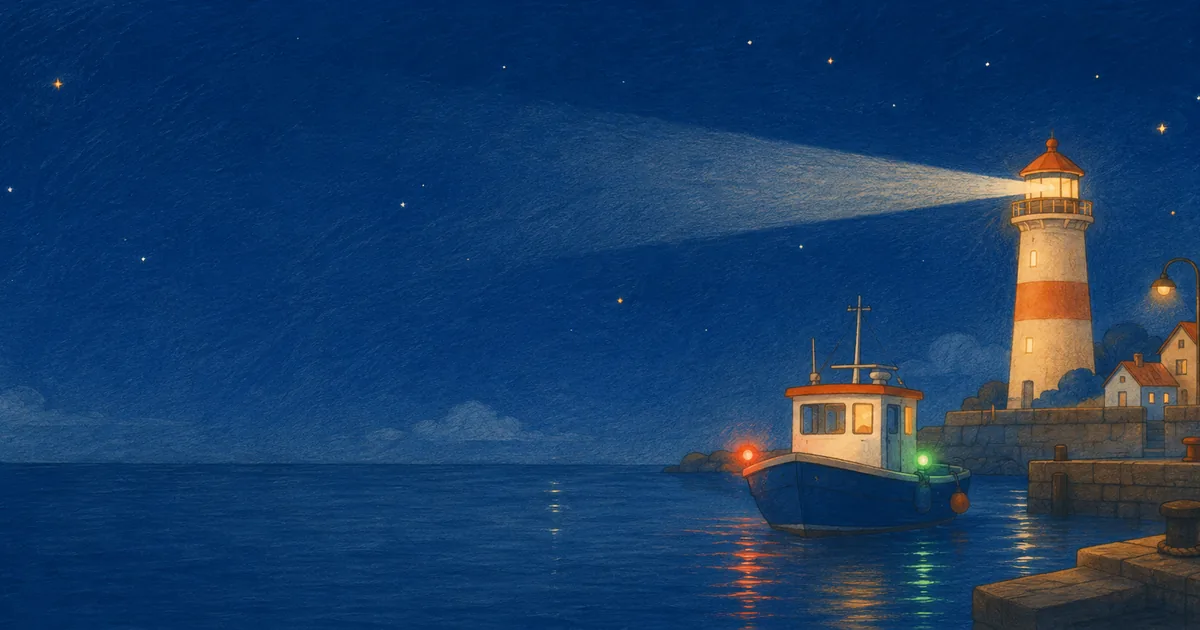
At night, the scattered lights out on the water are actually “speaking” to you: they tell you whether the vessel opposite is power-driven or under sail, which way its bow is pointing, whether it is at anchor or underway, and even whether it is not under command or restricted in its ability to manoeuvre. The PVO Grade 2 written exam loves testing these lights and day shapes, because they feed directly into collision-avoidance judgements — and they make up the largest single block of questions on the paper. The good news is that light questions follow a fixed set of combinations — learn them well and they become reliable marks. This guide breaks them down one by one, with illustrations and quick-reference tables. If you want to work through the picture questions as you read, pair it with the “10-Minute PVO Boat Licence” app: 903 questions covering both Part A and Part B, with the light and shape image questions supported by diagrams and detailed explanations. Wrong answers go automatically into wrong-answer review — ad-free and free to download.
It all starts with "red port, green starboard"
The foundation of the whole navigation-light system is the two colours of the sidelights: red on the port side, green on the starboard side. Those words — “red port, green starboard” — are worth memorising cold from the outset, because they turn up not only in light questions but also run right through the collision-avoidance Rules and the buoyage system covered later. Each sidelight shines over only a fixed arc ahead, so when you see the colour of the other vessel’s light, you know exactly which side of it you are looking at.
Red sidelight
Port (left) side
Green sidelight
Starboard (right) side
Masthead / sternlight
White (forward / aft)
Besides the two sidelights, there are two white lights to recognise: the masthead light, mounted high on the fore-and-aft centreline towards the front of the vessel and shining forward; and the sternlight, mounted at the stern and shining aft. Fix “red port, green starboard, white fore-and-aft” in your memory and you can assemble the light combination of almost any vessel. As for special states — not under command, restricted in ability to manoeuvre, fishing, pilot and so on — these simply add a group of vertical all-round lights on top of these four, which we unpack one by one below.
The horizontal arcs and specifications of the five light types
Beyond colours, light questions often test the “horizontal arc” directly as a number. Each light is visible only over a specific angular range, and this is precisely what lets others judge your heading from your lights. The following five arcs are must-memorise marks: masthead 225°, sidelights 112.5° each, sternlight 135°, all-round light 360°; the towing light has the same arc as the sternlight but in yellow.
Beyond the arcs, a few more numbers come up often: a flashing light flashes at 120 or more flashes per minute; for sound signals, a short blast lasts about 1 second and a prolonged blast 4 to 6 seconds — fill-in questions often ask the blast duration, so answer “4 to 6 seconds”, not “3 seconds” or “5 seconds”. Another detail that gets overlooked is the sidelight screen: on vessels under 20 metres, the sidelights must have inboard matt black screens to prevent light showing beyond the sector and to avoid reflection, so that other vessels do not misjudge the heading; a combined lantern needs only a very narrow division between the green and red sections.
Working back from the lights to the aspect you are seeing
The exam doesn’t just ask “what light is this” — more often it asks “what situation does this set of lights represent”. The most effective approach is first to work out the aspect from which you are viewing the other vessel:
This table effectively ties the light questions to the collision-avoidance Rules. When you see lights on the exam paper, don’t stop at “red means port side”; go a step further and ask: I am seeing the other vessel’s port side, so what is the relative aspect of the two vessels? Who should keep their course? Who should take early and substantial action to keep clear? Note the last row — seeing only the sternlight at night with neither sidelight is the standard test for “you are overtaking her” (because you are in the arc more than 22.5° abaft her beam).
The light combination of a power-driven vessel (by length)
A power-driven vessel underway is the “baseline” of light questions: it shows a masthead light, two sidelights and a sternlight all at once. In practice, though, how many lights it shows changes with length. The 50-metre line is a favourite: 50 metres or more must show two masthead lights fore and aft (the after one higher than the forward one), while under 50 metres needs only one. Memory cue: large vessel = twin masts, small vessel = single mast.
Most Grade 2 pleasure vessels fall in the under-12-metre category, so the simplified “one all-round white light + two sidelights” combination is the one most often seen in questions and in real life. When one comes towards you at night, if you see both the red and green sidelights together with the white masthead light above them, you can be fairly sure it is a power-driven vessel steaming straight at you — which corresponds exactly to the head-on situation in the collision-avoidance Rules.
Sailing vessels, sail-and-engine, and vessels at anchor
The biggest difference in lights between a sailing vessel and a power-driven vessel is that a sailing vessel has no masthead light: when underway it shows only its two sidelights and a sternlight (it may optionally add a set of red-over-green all-round lights at the masthead — not mandatory; a sailing vessel under 20 m may use a combined tri-colour lantern at the masthead). So the key question when identifying it at night is — is there a forward white masthead light? If not, it is most likely a sailing vessel. Watch out for a favourite trap: if a sailing vessel is also being propelled by its engine, the Rules treat it as a power-driven vessel and it must show a masthead light, and by day it must exhibit a cone with the apex pointing downwards forward. In other words, a “sailing vessel using its engine” no longer enjoys the status of a sailing vessel, either in its lights or in the give-way order.
A vessel at anchor is another combination to remember. At night it shows an all-round white light — a white light visible all round the horizon; by day it exhibits a black ball shape forward. A longer vessel (generally 50 metres or more) shows two anchor lights, the forward one higher and the after one lower. As for very short vessels, they may be exempt in specified circumstances. The table below sets the three most basic states side by side so the key distinctions jump out:
Towing, not under command (NUC) and restricted in ability to manoeuvre (RAM)
When a vessel cannot give way in the ordinary way for some reason, the Rules require it to show an extra group of vertical all-round lights, announcing its special state all round the horizon. This group is the easiest place to lose marks, because the states are similar and there are many lights — but once you fix on “how many in a vertical line, and what colour”, you can decode them.
A vessel not under command (NUC) is one that has lost the ability to manoeuvre and cannot keep out of the way as required by the Rules: at night it shows two all-round red lights in a vertical line; if still making way through the water, it adds two sidelights and a sternlight; by day it shows two black balls in a vertical line. A vessel restricted in her ability to manoeuvre (RAM) is one restricted by the nature of her work (such as laying cable, dredging or minesweeping): at night it shows three all-round lights red-white-red in a vertical line, and by day ball-diamond-ball. The mnemonic is simple — NUC is “two items”, RAM is “three items”.
RAM branches into a few variants: a vessel engaged in dredging or underwater operations shows, in addition to the RAM signals, two all-round red lights or two balls on the side of the obstruction (red = danger = do not pass) and two all-round green lights or two diamonds on the clear side (green = safe = may pass). A vessel constrained by her draught shows, at night, three all-round red lights (vertical) on top of the normal power-driven vessel lights, and by day a cylinder.
Towing and pushing are another common test. A tow length of 200 metres is the dividing line: for a tow length under 200 metres, the towing vessel shows two masthead lights in a vertical line, plus sidelights, one yellow towing light and a sternlight; over 200 metres it shows three masthead lights in a vertical line, and by day a diamond shape must be exhibited on both tug and towed vessel. The vessel being towed itself shows only two sidelights and a sternlight (no masthead light). A vessel pushing ahead (not a composite unit) has the same lights as a towing vessel with a tow under 200 metres, but shows no yellow towing light — “is there a yellow towing light?” is exactly what distinguishes towing from pushing.
Fishing vessels, pilot vessels and vessels aground
Fishing vessels come in two kinds, trawling and non-trawling, and the light colour is the only difference: at night a trawling vessel shows all-round lights “green over white” in a vertical line, while a non-trawling vessel shows “red over white”; both add sidelights and a sternlight. The cue “trawling = green on top” fixes it. By day both show two cones with their apices together (an hourglass); a non-trawling vessel whose gear extends more than 150 metres also adds an all-round white light in the direction of the gear (by day, a cone with the apex pointing upwards).
A pilot vessel engaged on pilotage duty shows, at night, all-round lights “white over red” in a vertical line, plus sidelights and a sternlight; the International Regulations prescribe no day shape for a pilot vessel, while Hong Kong pilot vessels fly a white-over-red flag. A vessel aground shows, on top of the anchor light(s), two all-round red lights in a vertical line at night, and three balls in a vertical line by day — which neatly strings “at anchor, not under command, aground” into one memory line: one ball at anchor, two balls not under command, three balls aground.
Day shapes: ball, diamond, cylinder and cone
In good daylight, relying on lights is unreliable, so the Rules switch to black geometric shapes to convey the same message. There are four basic shapes to recognise:
Ball
At anchor (one, forward)
Diamond
Restricted in ability to manoeuvre (in the middle)
Cone
Sailing vessel also using engine (apex downward)
Cylinder
Vessel constrained by her draught
Each of the four shapes has its meaning; setting out how they combine makes it clearer still:
Combining the shapes gives the important combination for a vessel restricted in her ability to manoeuvre — three shapes in a vertical line by day: “ball – diamond – ball”. When you see two balls above and below with a diamond in between, you know the other vessel finds it hard to give way under the ordinary Rules and you should keep clear of her. For how this set of shapes relates to collision-avoidance responsibilities, see the article on collision-avoidance Rule essentials.
Master summary of night lights and day shapes by vessel type
Putting every vessel type’s night lights and day shapes together gives this core quick-reference table. Just before the exam, cover the answers and self-test to find the rows you still haven’t locked in:
Fog signals at a glance: one prolonged, two short, four short
In restricted visibility (dense fog, for example), neither lights nor shapes can be seen clearly, so the Rules rely on sound signals. The key to a fog signal is “one prolonged blast” plus a varying number of short blasts, combined with the interval of sounding. This group is a favourite fill-in question, and getting the number of short blasts or the interval wrong costs marks.
This table holds several high-frequency points: a power-driven vessel sounds one prolonged blast underway and two prolonged when stopped — don’t answer “1 minute” instead of “2 minutes”; sailing, NUC, RAM, towing and fishing vessels underway all sound “1 prolonged + 2 short”; a vessel being towed sounds “1 prolonged + 3 short” (one more short than the tug) and must sound it immediately after the tug; a pilot vessel’s “1 prolonged + 4 short” is the only fog signal among all vessel types ending in four short blasts, which makes it easy to spot. A vessel at anchor does not use the whistle but rings the bell rapidly for about 5 seconds at intervals of not more than 1 minute (vessels 100 m and over ring the bell forward and sound the gong aft).
Common traps on the PVO written exam
Mistakes on light questions usually come not from a total lack of understanding, but from mixing up similar states. Just before the exam, it is worth checking these points in particular:
As soon as it is under mechanical propulsion it is treated as a power-driven vessel; by day watch for the cone with its apex pointing downward.
NUC = two red lights / two balls (two items); RAM = red-white-red / ball-diamond-ball (three items). Count the items and you won't confuse them.
One ball at anchor, two not under command, three aground; aground adds two all-round red lights on top of the anchor lights.
Trawling green over white, non-trawling red over white, pilot white over red — three pairs easily swapped, so hold them by the cue.
Under 200 m = two masthead lights; over 200 m = three masthead lights, with a diamond on both tug and tow by day.
Power-driven: 1 prolonged underway / 2 prolonged stopped; towed vessel 1 prolonged + 3 short, pilot 1 prolonged + 4 short — don't get the short count wrong.
Lights and shapes may look like fussy detail, but the backbone comes down to just a few sets: the red-port, green-starboard sidelights; the white masthead light and sternlight; the four horizontal arcs; the four shapes; and the group of vertical all-round lights and fog signals layered on top. Learn the logic of assembling these few sets, and you will not only identify them quickly on the exam paper but also read, at a glance, the intentions of other vessels out on the water during a real night passage.
The light, shape and fog-signal content in this article is compiled from the International Regulations for Preventing Collisions at Sea, 1972 (COLREGs); for details such as vessel-length exemptions, please refer to the text of the Convention and to the Marine Department’s materials.
Lights, collision avoidance and buoyage are three topics that reinforce one another:
- International collision-avoidance Rules: which vessel gives way when two meet
- IALA buoyage system at a glance: Hong Kong is Region A, red to port, green to starboard
- Grade 2 Pleasure Vessel Licence exam: full guide to the Part A and Part B scope and revision order
- Back to home — learn about the "10-Minute PVO Boat Licence" app
Turn this guide into your next practice
- Choose the part you need to improve: navigation, seamanship and safety in Part A, or marine engineering in Part B.
- Revisit the relevant guide: COLREGs · lights and shapes · buoys · marine engineering。 Explain the distinguishing condition before answering other questions in the app.
- On your next visit, retry mistakes without looking at the explanation. Then use the official Part A and B samples to check the question format and practise timing.
Download the PVO app free to try. Pro content, access period and price are shown in the app store screen. Website and app records are saved separately.