Part B tests marine engineering knowledge, and many candidates lose their nerve the moment they see the words “engine” or “fuel system”. In truth, Part B does not require you to become a mechanic — you only need to understand how a vessel “gets moving” and how it “stays safe”. This guide uses systems thinking to organise the engine cycle, fuel, cooling, lubrication, electrical, steering and pumps, along with the most life-critical topics of all — fire prevention, LPG and the environment — one by one, so that you answer through understanding rather than brute memory. Working through it alongside the “10-Minute PVO Boat Licence” app is more efficient still: its 903 questions cover both Part A and Part B, the mechanical questions come with detailed explanations, wrong answers drop automatically into the wrong-answer review, and it is ad-free and free to download.
Engine Structure: The Four-Stroke and Two-Stroke Cycles
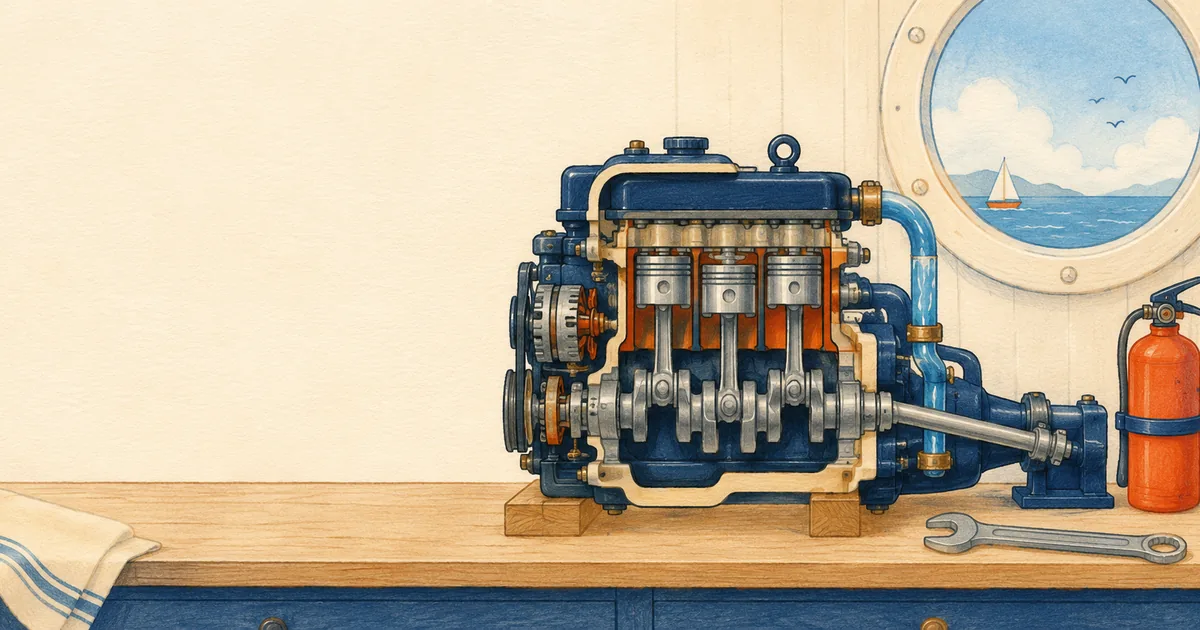
Engines on board are reciprocating internal-combustion engines, and understanding the cycle is the entry point for Part B. “Four-stroke” means the piston travels up and down four times and the crankshaft turns twice (720°) to complete one full power cycle:
1. Intake
Draws in the air-fuel mixture
2. Compression
Piston rises and compresses the mixture
3. Power
Ignition and combustion drive the piston down
4. Exhaust
Piston rises and expels the burnt gases
Intake, compression, power, exhaust — the four steps interlock, and only the power stroke delivers drive; the other three are carried through by the rotational inertia stored in the flywheel, which smooths running and reduces vibration. Once you map each step to its valve and piston action, you can see why poor intake, insufficient compression or mistimed ignition will all leave the engine gutless or hard to start.
The two-stroke cycle is entirely different: the piston completes only two strokes and the crankshaft one revolution (360°) per power stroke. Two-strokes are common in petrol outboards: the mixture enters the crankcase through a reed valve, is pressurised as the piston descends, and forced into the cylinder when the transfer port opens; exhaust and scavenging happen together, with no separate induction stroke. A classic trap lives here: on a four-stroke the camshaft turns at half crankshaft speed, but on a two-stroke — with a power stroke every revolution — the camshaft speed equals the crankshaft speed. Do not confuse them.
Study strategy: don’t memorise four nouns — picture the piston’s up-down rhythm. Whenever a question mentions the camshaft or power-stroke frequency, first ask “is this four-stroke or two-stroke?” and the answer almost writes itself.
Petrol vs Diesel Engines
Both are reciprocating internal-combustion engines; the fundamental difference is the ignition method. A petrol engine mixes fuel with air, compresses it, and ignites it with a spark plug — spark ignition. A diesel engine compresses pure air to high temperature and pressure, then an injector sprays atomised diesel that self-ignites on the heat of compression — compression ignition, no spark plug needed. Precisely because diesel needs high temperature to ignite, the diesel’s compression ratio must be far higher.
This single difference drives a chain of exam points: compression ratio (petrol about 7:1 to 10:1, diesel up to 20:1 or higher), flash point (petrol about −40°C, diesel about +63°C), engine weight, and shutdown method. Petrol’s very low flash point means it evaporates heavily at ambient temperature and carries a far higher fire risk than diesel, which is why ventilation of a petrol engine room is so critical.
Common trap: never stop a diesel with the decompression lever (exhaust-valve lift bar), as unburned fuel entering the exhaust is a fire hazard — the correct method is always to cut the fuel. Another classic: put diesel into a petrol engine and the starter will still crank it, but the low compression ratio and spark ignition cannot readily fire the higher-flash-point diesel, so it will not run properly. Study strategy: memorise the “three pairs” (compression ratio, flash point, shutdown method) as one set — most multiple-choice questions set their distractors among these three.
Fuel System: From Tank to Combustion Chamber
The job of the fuel system is to deliver clean fuel, in the right quantity, steadily to the combustion chamber. A typical supply path runs: fuel tank → fuel line → filter (often with a fuel-water separator) → fuel pump → carburettor or injector → combustion chamber. The marine environment is damp, and once water or debris gets into the fuel it makes the engine run rough or, worse, stalls it — so regularly changing the filter and draining the water separator is key to reliability.
The petrol engine carburettor works on the Venturi principle: air speeds up through the throat, its pressure drops, and petrol is drawn out of the jet to form a mist. A high-frequency trap lives here — candidates often assume pressure rises at the throat, but by Bernoulli’s principle faster flow means lower pressure. The float chamber holds a steady fuel level via a float and needle valve; if the float is punctured and sinks, the needle cannot close and the carburettor floods. The quickest remedy is to shut off the fuel system and crank the engine several times to draw off the excess — never close the choke (that enriches the mixture further). The choke only enriches the mixture for cold starting and must be reopened once warm, or the spark plugs foul with carbon.
Modern petrol engines mostly use electronic fuel injection (EFI): an ECU calculates injection quantity and ignition timing from multiple sensors, giving better atomisation, economy and lower emissions — at the cost of being moisture-sensitive and impossible to hand-start with a flat battery. Diesel engines use a high-pressure jerk pump to inject diesel at 69 to 140 bar through a multi-hole nozzle, with a governor to prevent overspeed or stalling; if air enters the fuel lines, its high compressibility makes injection erratic, and you must bleed (prime) the system to expel it.
Cooling System: Carrying the Heat Away
A running engine produces a great deal of heat; if it is not carried away, the metal parts overheat, distort and can seize. Marine cooling comes in two main types. Direct raw-water cooling pumps seawater straight through the engine water jacket — simple, no heat exchanger — but the jacket accumulates scale, barnacles and silt, restricting flow and corroding metal. Indirect freshwater cooling circulates a closed freshwater loop through the engine, then passes it through a heat exchanger where seawater flowing outside the tubes removes the heat; only freshwater touches the engine, greatly reducing corrosion, and this is the most common marine method. The thermostat holds the working temperature: closed at start-up to speed warm-up, opening once up to temperature — so a “fully open thermostat” means the water temperature is already high, a common counter-intuitive question.
Seawater is drawn in by an impeller pump (rubber vanes), and the impeller is a wear item; the system usually carries a zinc sacrificial anode, which corrodes preferentially because zinc is more reactive, protecting the other metals. After getting under way, build the habit of confirming that cooling water is discharging overboard (on an outboard, watch the tell-tale stream at the drive leg). If a temperature warning appears, the correct sequence is to slow down first to reduce load, let the engine cool naturally, then act — never pour cold water onto a hot engine (thermal shock cracks the metal); the header tank is still under pressure when hot, so open the cap carefully. Never run an outboard out of the water, or the impeller runs dry and, lacking water for lubrication and cooling, the pump is quickly damaged — a question asked at nearly every sitting.
Lubrication: Five Functions and One Safety Response
Lubricating oil has five basic functions: reduce friction and wear, dissipate heat (carry away frictional heat), clean (remove metal particles and carbon), seal (the oil film between piston rings and cylinder wall prevents pressure loss), and prevent corrosion. Four-stroke engines use wet-sump pressure lubrication: oil is held in the crankcase, pressurised by the oil pump, and delivered through fine crankshaft drillings to the bearings; two-stroke outboards instead mix oil into the fuel (typically 50:1).
The one safety response to memorise is simple: oil pressure should rise immediately after starting, and if oil pressure falls to zero, stop the engine at once. Otherwise the parts lose their oil film and dry friction at speed rapidly generates heat, melting or seizing the bearings. Note that topping up the oil does not fix zero pressure — the bearings may already be damaged, so you must stop first. The oil itself reveals faults: emulsified oil (milky) usually means coolant leaking into the sump (e.g. a blown head gasket); oil turning black with a rising level suggests diesel dilution. Higher SAE viscosity numbers are thicker and suit high temperatures; at sea, if the specified grade is unavailable, choose a lower number for its fluidity.
Outboard (Stern) Engines
The difference between outboard and inboard engines is a high-frequency topic. On an inboard, power runs through the tail shaft in the stern tube to the propeller, and thrust is absorbed by the thrust bearing and passed to the hull. On an outboard, power runs through bevel gears and a vertical drive shaft to the external propeller, and thrust is absorbed by the transom bracket — so no thrust bearing is required, and no separate rudder either, since steering is done by pivoting the whole engine unit.
A few operating points must be memorised. A two-stroke outboard needs oil mixed into the fuel at the maker’s ratio (typically 50:1); too much oil fouls the spark plugs and causes misfiring. The kill cord clips to the operator’s wrist or lifejacket, and the instant they leave the helm the clip disengages and the engine stops — so if an engine will not start, the first thing to check is often whether that clip is properly inserted. The propeller is protected by a shear pin, which breaks on impact to separate the shaft from the propeller; once struck, it must be replaced regardless of severity, and no other metal may be substituted. The first two steps to start a small outboard are “lower the engine to its down-locked position” and “confirm neutral gear”; when not in use, tilt the engine up to no more than 90° so the cooling system drains and salt does not accumulate. Study strategy: remember the two counter-intuitive points — “an outboard needs no thrust bearing” and “running it out of the water damages the pump” — and most traps fall apart.
Electrical System and Battery
The battery powers starting and the vessel’s electrics, and most vessels use lead-acid batteries: each cell is 2.0V, and a common 12V battery is six 2V cells in series. A hydrometer measures electrolyte specific gravity to show the state of charge — about 1.277 at full charge, with voltage about 12.73V; electrolyte should sit 6 to 12mm above the plates, and you top up only with distilled water, never tap or sea water. Keeping the terminals clean, tight and greased with Vaseline is one of the most overlooked yet trouble-saving steps.
Charging safety is heavily tested: charging a lead-acid battery releases hydrogen, which combines explosively with oxygen when ignited, so the battery compartment must have no naked flame, good ventilation, and an explosion-proof motor on the exhaust fan. Charging current must not exceed 10% of battery capacity (max 12A for a 120Ah battery) — more current means more heat and hydrogen. On the electrical side, a blown fuse may only be replaced with one of the same rating; never substitute a thicker wire or a higher-rated fuse to mask the problem, and repeated blowing means the circuit definitely has a fault. If someone in the engine room suffers an electric shock, the first action is to cut the power or pull them clear with an insulated object — never grab them directly — then administer CPR or the recovery position depending on breathing and pulse.
Steering and Pumps
Steering gear comes in two main types. Small craft commonly use mechanical chain-and-linkage steering — simple and reliable, with maintenance focused on lubrication and rust prevention, checking pulley bearings, and periodically removing the rudder to check clearance. Larger vessels use hydraulic steering, where the wheel drives a pump that moves oil between the port and starboard cylinders to turn the rudder; three numbers to memorise are 35° each side, 70° from full port to full starboard, and 28 seconds to complete power-assisted steering. Trapped air causes an air-lock, making the rudder slow or erratic, cleared by bleeding each cylinder in turn. Any steering failure calls for the emergency tiller on the rudder stock’s square head; on a hydraulic system, open the bypass valve first.
Pumps split into two families: dynamic pumps (e.g. centrifugal) and positive-displacement pumps (e.g. reciprocating, gear, impeller). Reciprocating pumps are self-priming with high output head; a centrifugal pump installed above the liquid level must be primed (casing filled) before starting, and its most common failure is “air in the casing”, so suction pipes must be rigid metal to stop a soft hose collapsing under vacuum. For the bilge system, even with an electric bilge pump you should fit a manual pump as a backup for power failure; oily bilge water must not be allowed to accumulate, since it is flammable and a fire hazard.
Reasoning From Fault Symptom Back to System
The most valuable way to revise Part B is to connect common symptoms with the systems behind them. Underway you should continuously watch: RPM, coolant temperature and flow, oil pressure and temperature, exhaust temperature and condition, and engine noise and vibration; plus three engine-room items — stern tube gland, bilge water level, and ventilation. When the exam asks “what should you check if the engine overheats”, it is not trying to make you a boat mechanic — it is testing whether you can troubleshoot with safety logic.
Exhaust smoke colour is a very high-frequency topic; each colour has one cause. Black smoke = air-starved, incomplete combustion (check the air filter, reduce load); blue smoke = lubricating oil burning in the chamber (worn piston rings or too much oil); white smoke = cooling water leaking past the head gasket and vaporising.
Routine Operation and Maintenance
The right start-and-stop procedure greatly reduces wear. Before starting (especially after a lay-up), the very first action is to ventilate thoroughly and expel accumulated flammable vapour before switching on electrics or starting. After starting, let the engine idle briefly so the oil pump builds the oil film and the pressure rises to its rated value — do not apply high speed or load immediately. Before stopping after full speed, idle to cool down evenly (especially to protect the turbocharger), then set the transmission to neutral and hold the stop control — petrol cuts the ignition, diesel cuts the fuel.
For maintenance, follow the manufacturer’s schedule and use preventive, not run-to-failure, maintenance. Typical intervals: main engine oil and filter every 3 months or 150 hours, gearbox oil every 12 months or 500 hours; check drive-belt deflection at the longest span, correct value 25 to 30mm. Stringing the systems together gives you a pre-departure checklist — building the habit of running through it every time matters more than the exam, because it bears directly on the safety of you and your passengers.
Fire Prevention and Firefighting: The Most Important Lesson on Board
At sea, fire is more dangerous than on land — there is nowhere to escape, and help takes time to arrive — which makes fire prevention the part of Part B (and of the whole exam) that most deserves your attention. A fire needs three things: fuel, oxygen and heat — all three together, the “fire triangle”; the modern model adds the chemical chain reaction to form the “fire tetrahedron”. To prevent or put out a fire, you remove one of them or break the chain. Different fire classes need different methods, and that is the core of every firefighting question.
Each extinguisher has its uses and prohibitions, another common marks-loss point. The one rule to burn in: never use water on a fuel or electrical fire — water scatters burning oil, and on an electrical fire it risks electric shock.
Aim foam at the bulkhead: When fighting an oil fire, aim foam at the adjacent bulkhead so it spreads over the flames — never aim directly at the flames (which scatters burning oil).
Beware flashover: A sealed, smoke-filled space accumulates combustible vapour, and suddenly opening a door to admit oxygen can trigger a "flashover" — open doors very slowly; crawl low to escape and keep smoke doors closed.
Steering also changes with the fire’s location: for a bow fire, steer downwind so smoke blows ahead of the bow, away from persons; for a stern fire, steer upwind so smoke blows astern and does not spread to the bow. For a passenger-cabin fire, the principle is “save life, then fight fire, then call for help, then handle the vessel”: sound the alarm and evacuate passengers, attempt to extinguish and call for help by VHF or 999, then turn downwind, close windows and cool with water, and only lastly have passengers don lifejackets ready to abandon ship.
LPG and the Environment
LPG (liquefied petroleum gas) is stored in cylinders at 80 psi, reduced by a regulator before it reaches appliances. The single most important point is that LPG is heavier than air — a leak sinks and collects in low areas or the bilge, so ordinary window ventilation does little for gas pooled at the bottom, and you must check the bilge specifically. It is highly flammable — even a lit cigarette or the faintest electrical spark can ignite it — and while it is not toxic, inhaling a lot dulls the sense of smell, making a leak harder to notice. On installation, cylinders must be stored upright, away from heat sources, with a maximum of 50 kg on board, and appliances must bear the EMSD-approved “GU” mark and an automatic gas cut-off.
Leak response has three prohibitions: no open flame, no smoking, no starting engines. Check for leaks by spraying soapy water and watching for bubbles — never with a flame; if you smell gas, alert everyone, disconnect the cylinder regulator and move it to the open deck, and switch no electrical device until thoroughly ventilated. To disperse gas from the bilge, use canvas as a wind scoop or vigorously wave a canvas or blanket — never use an electric fan or extractor, since the switch alone can ignite the pooled gas. Before leaving the vessel, close the appliance valves first, then the regulator or main cylinder valve.
The environment is a Part B topic too: oily bilge water must not be discharged overboard — pump it to the waste oil tank and return it ashore for chemical waste disposal; using detergent to emulsify the oil before discharge is equally illegal. Illegal discharge at sea carries heavy fines. These are both legal requirements and the basic conscience of a responsible operator.
Pre-Exam Self-Test: Is Your Part B Solid Enough?
Just before the exam, do not just look at “how many questions I have done” — look instead at whether you can answer the following without opening a book:
- Can you name the four strokes in order, and explain why a two-stroke camshaft turns at the same speed as the crankshaft?
- Can you distinguish petrol and diesel by ignition method, compression ratio, flash point and shutdown method?
- Can you compare direct raw-water and indirect freshwater cooling, and explain what a fully open thermostat means?
- Can you list the five functions of lubricating oil and the immediate response to zero oil pressure?
- Can you explain why an outboard needs no thrust bearing, and what running it out of the water damages?
- Can you match fire classes A/B/C/E to their agents, and remember that water is never used on oil or electrical fires?
- Can you state the two implications of LPG being heavier than air, and the three leak prohibitions?
If any of these comes out vague, go back to the relevant section and drill the questions. Improvement in Part B usually comes from joining up these cause-and-effect chains; once you understand “what symptoms appear when a system goes wrong”, the wrong options become easy to eliminate.
At its core, Part B is a kind of common sense about “operating a vessel safely”: understanding how the engine works, how the fuel and cooling systems work together, how the electrical and steering systems run, and how to guard against fire and gas. Rather than treating it as a difficult mechanical subject, treat it as a checklist for taking responsibility for yourself and your passengers. Once you understand the principles, and then drill the questions until the scenarios feel familiar, Part B turns from the part candidates fear most into the most practical and personally relevant part of all.
This article is a general introduction to marine engineering knowledge; actual operation and maintenance must follow the vessel manufacturer’s guidance, and safety-equipment requirements and regulations should follow the information published by the Marine Department.
Once Part B is sorted, don't forget the image-based topics in Part A:
Turn this guide into your next practice
- Choose the part you need to improve: navigation, seamanship and safety in Part A, or marine engineering in Part B.
- Revisit the relevant guide: COLREGs · lights and shapes · buoys · marine engineering。 Explain the distinguishing condition before answering other questions in the app.
- On your next visit, retry mistakes without looking at the explanation. Then use the official Part A and B samples to check the question format and practise timing.
Download the PVO app free to try. Pro content, access period and price are shown in the app store screen. Website and app records are saved separately.